Last Updated on September 30, 2026 by David
Ceramic tile restoration effectively addresses issues such as grout haze, mould, residue, and ingrained soil. Grout haze manifests as a thin, cloudy film on tile surfaces, often visible as streaks; appropriate cleaning methods can eliminate this. Mould, a visible fungal growth, typically presents as dark spots in grout joints, and specific treatments can eradicate the visible growth. Residue lock-in refers to cleaning residue or soil that remains on the tile surface, manifesting as persistent dullness or patchiness; targeted cleaning can effectively release it. restoration cannot recreate a chipped factory finish, reverse deep glaze damage, or level an uneven installation. The crucial factor to consider is whether the unsightly appearance is on the tile, within the grout, or due to tile damage itself.
Understanding What Ceramic Tile Restoration Can Fix: Exploring Different Damage Levels and Common Pitfalls
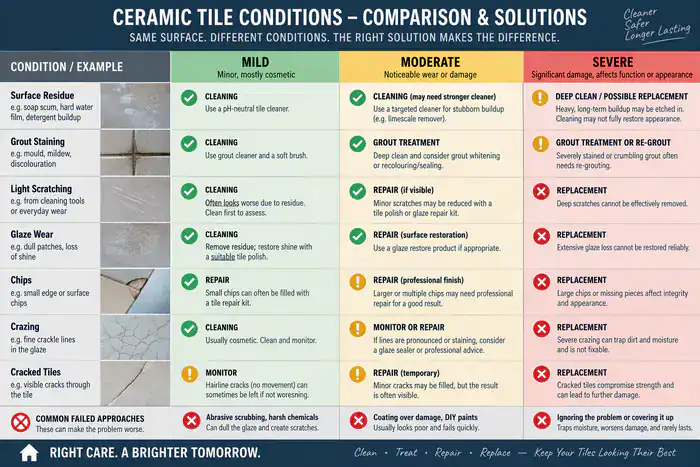
If a section of your ceramic tile appears cleaner in certain lighting but still draws attention at a lower angle, this improvement might simply indicate that contamination has been removed, not that surface damage has been reversed. To accurately assess the results, compare the area with an undisturbed tile under similar lighting. A noticeable difference in sheen, colour, or surface continuity may indicate altered grout or glaze damage, rather than remaining soil that still needs to be addressed.
Surface contamination that is removable typically spans across the tile face or settles into its texture, while the underlying tile maintains its original appearance. Installation residue, detergent film, hard-water deposits, and embedded dirt can create a misleading impression of wear, even when the visible ceramic surface remains intact.
Altered grout presents a distinct pattern. Colour loss manifests as fading or uneven loss of the grout’s original hue, appearing as pale or patchy joints. While cleaning may remove surface staining, it cannot restore lost colour; thus, grout recolouring or renewal might be necessary. Darkened joints and patchy staining follow the contours of the joints rather than the shape of the tile faces. Restoration can enhance the appearance of the frame surrounding each tile but will not alter the factory finish of the tile itself.
Physical damage establishes a clear boundary. Chips, deep scratches, and exposed porous tile bodies disrupt the original surface. The material beneath may retain soil more readily than an intact surface and cannot regain its fired appearance through standard cleaning methods.
Glaze crazing failure results in a network of fine cracks across the decorative surface. You may observe hairline cracks, darkened fissures, or localised staining. While restoration can remove loose contamination around these areas, it cannot recreate a continuous glaze; in severe cases, matching tile replacement may be necessary.
Common pitfalls include abrasive scouring, the use of unsuitable acidic products, and attempts to conceal a damaged surface with a coating. These methods can exacerbate fine scratches, leave behind residue, or blur the line between recoverable appearance issues and permanent material defects.
How to Differentiate Residue from Discoloured Grout: Understanding Soil Behaviour on Ceramic Tile and Grout
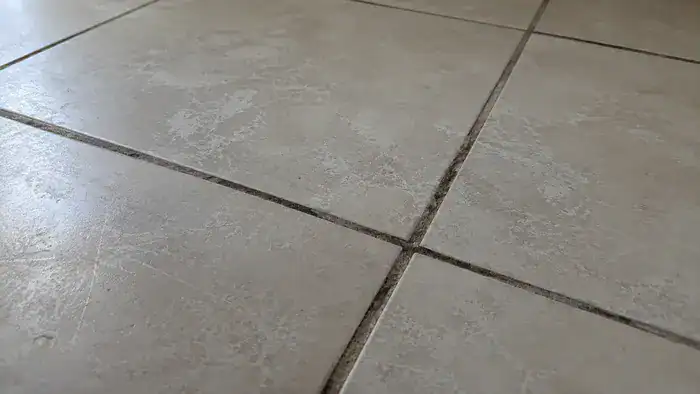
Residue typically rests on the ceramic tile surface, while discoloured grout usually follows the pattern of the grout joints. Examine both under the same lighting conditions before treating similar-looking marks as identical issues. A film stretching across multiple tiles suggests surface residue, while persistent darkening along the joints indicates soil trapped within the porous cement-based material.
The porosity of cementitious grout provides a pathway for absorption that a glazed tile surface lacks. Capillary voids within the cementitious structure can absorb cooking grease, body oils, detergent residue, and mineral films. contamination can penetrate below the apparent surface even after repeated mopping.
Residue on the tile surface behaves more like a covering than a stain within the tile itself. Polymer bonding can leave a stubborn film after installation, while soap scum, limescale, and cleaning product residue contribute to surface clouding. This pattern often spans several tiles and shifts as light moves across the surface.
Darkening confined to the joints indicates a different soiling mechanism. Soil absorption causes grout staining and colour degradation within the porous structure. This explains why wiping the adjacent tiles may leave the joint pattern unchanged, and why a visually similar mark may require grout renovation rather than additional cleaning of the tile surface.
Professional deep cleaning distinguishes these conditions by evaluating location, persistence, and response in a small test area, rather than applying a single chemical solution across the entire installation. Further details on the differences between surface residue and soil held within joints are covered in this guide to deep cleaning ceramic tile floors, where extraction and grout agitation receive separate attention.
A tile that appears clean adjacent to persistently dark joints has not necessarily undergone an unsuccessful restoration. It may simply indicate that the non-porous surface has returned to a clean state, while the absorbent grout joint still requires colour restoration, repair, or protection.
How Material Origin, Manufacture, Internal Structure, and Finish Affect Cleaning Methods for Ceramic Tiles
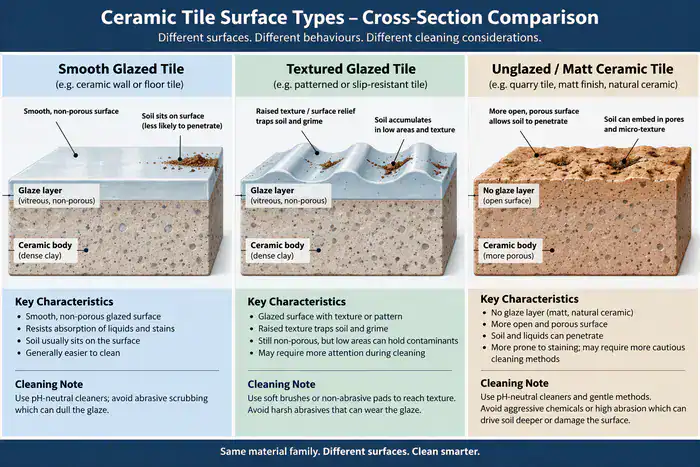
Repeatedly scrubbing a patchy floor can complicate diagnosis rather than achieving a cleaner surface. Ceramic tile consists of a kiln-hardened body topped with a decorative finish; the type of finish, surface relief, and joint geometry all influence where soil accumulates and how much visible variation persists after restoration.
Textured tile grooves can retain visible soil even when the glazed surface remains intact. Anti-slip ridges, riven effects, and embossed patterns create sheltered areas where fine particles, detergent film, and cooking grease evade standard cleaning methods. Controlled mechanical agitation can enhance appearance, but aggressive abrasion risks damaging the finish or altering slip-rating performance.
Texture can trap soil even when the glazed tile surface appears intact, meaning repeated dark lines do not necessarily indicate that the ceramic surface has failed.
Matt and non-reflective finishes also impact visual judgement. Dust marks, water spots, streaks, and cloudy areas scatter light across the surface, while a glossy finish reflects a clearer image. Both finishes can undergo the same restoration process yet still appear different when viewed from a low angle.
Tile lippage discrepancy refers to a vertical height difference between adjacent tiles. Uneven tile joints can snag a mop, collect dirt along a raised edge, and create changing shadows. While cleaning can reveal a cleaner installation, it cannot rectify the underlying height variation.
Installation geometry, therefore, influences the apparent result independent of contamination levels. A floor with consistent colour can still appear uneven if edge alignment varies across the room. Conversely, repeated dark lines within grooves may indicate retained surface dirt rather than lippage.
Material-sensitive evaluation is crucial. The behaviour of a soft nylon bristle pad and a polypropylene brush differs on smooth glaze, textured relief, and recessed grout. The broader behaviour of ceramic and porcelain installations is discussed in the ceramic and porcelain flooring resource, which examines finish, joints, and installation conditions collectively.
Understanding Why Glazed Ceramic Tiles Resist Stains While Damaged Areas Do Not
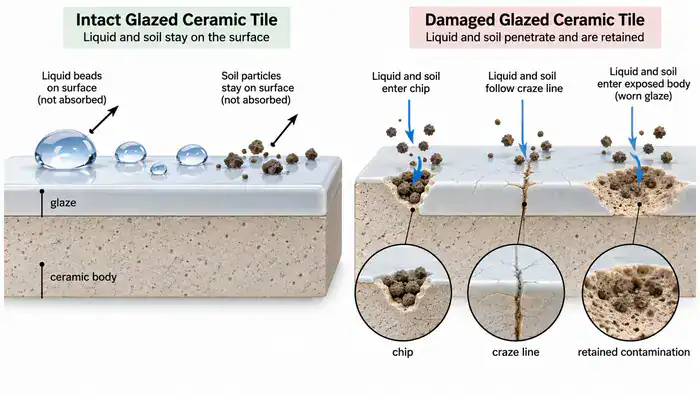
Abrading a glazed ceramic tile to remove a stain can lead to a more permanent issue. Inspect chips, fine crazing, and worn areas under raking light before concluding that the surface merely requires cleaning. A continuous factory-finished appearance around the mark supports a contamination explanation, while an interrupted surface suggests physical damage.
The factory-fired glaze forms a vitreous surface during kiln firing. Its non-porous structure provides a lasting finish and an impermeable layer over the ceramic body, so ordinary spills remain on the surface rather than penetrating the tile. Residue may still reside on top or accumulate within surface texture.
This resistance is why a glazed surface typically responds well to residue removal rather than restorative polishing. Mechanical abrasion risks cutting through the ceramic glaze, exposing the underlying material and creating fine scratches that retain soil. Methods suitable for natural stone or burnishable porcelain are not safe for glazed ceramic.
Glaze crazing failure disrupts the continuous finish with a network of hairline cracks. Thermal expansion mismatch can stress the glaze against the body, leading to dark dye absorption, dark lines, or moisture-related markings becoming visible within the fissures. While cleaning can improve the contamination around these areas, it cannot seal the cracks.
When a chip or deep scratch removes the top layer, an exposed porous tile body can occur. Water can infiltrate this porous surface, allowing mould to establish itself and disrupting the durable surface continuity. While cleaning may diminish visible soil, it cannot restore the absent protective layer.
Chips and worn areas necessitate different expectations than surface residue. If a suitable tile is available, a matching replacement can restore a continuous factory finish. A local repair may lessen visibility, but it cannot perfectly replicate the original glaze, pattern, and sheen.
Confusion often arises from polishing terminology. Non-abrasive buffing can eliminate cleaning residue, while diamond polishing pads or fine-grit sandpaper alter the surface itself. The distinction between apparent shine and permanent finish damage is also addressed in what polishing can and cannot achieve with ceramic tiles.
Understanding When Sealing Benefits Grout but Not the Tile Face, and How to Maintain Both Effectively
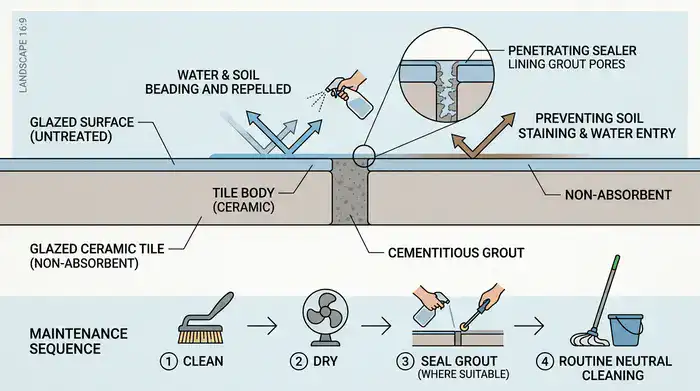
If a ceramic tile floor appears clean but the grout quickly darkens again, the absorbent joints are likely the weak point, not the surrounding tile face. The porosity of cementitious grout allows water, soil, and oily residues to penetrate capillary voids, causing visual inconsistency even while the glaze remains intact.
Grout protection works by penetrating pore sealing or applying a compatible surface coating that reduces absorption. An impregnating grout sealer creates an internal water-repellent barrier while maintaining breathability. Conversely, an epoxy grout colourant produces a durable non-porous finish where colour restoration and joint protection are needed together.
Protection cannot reverse colour degradation, fill missing joints, or repair a cracked tile. The factory-fired glaze already provides an impermeable barrier for the tile face; therefore, sealers applied to smooth glazed ceramic tend to remain as surface residue, attracting soil and complicating maintenance rather than enhancing the material.
Textured or worn areas require more careful consideration because grooves and scratches can mechanically retain soil. A specialist may assess whether an impregnator can reduce soil attraction within those features. it does not transform a damaged face into a new factory finish, nor does it justify indiscriminately sealing every tile.
Proper daily maintenance protects the grout frame and keeps the glazed surface free from residue, making the restored installation easier to care for. Using a pH-neutral tile cleaner, promptly removing grit before wet mopping, and ensuring careful drying in wet areas all contribute to this outcome. Avoid bleach and strongly acidic supermarket products, as these can strip colour or erode joints.
The distinction between effective grout protection and an unsuitable surface coating is explained in guidance on wax and sealant for ceramic tiles. Consistent care remains the most important factor in prolonging the life of the floor, as loose grit poses an abrasion risk, and repeated residue accumulation can restart the redeposition cycle.
Identifying Defects That Require Repair or Replacement: When to Escalate to Tier 2 Solutions
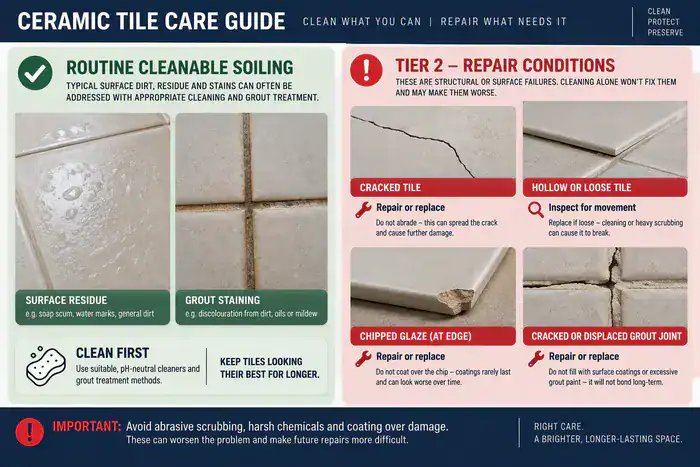
Misidentifying a cracked joint or chipped glaze as ordinary soiling can delay proper intervention. Observe the grout lines and tile edges: if the same defect persists after cleaning the surrounding surface, the condition may have progressed beyond routine restoration.
An effective assessment distinguishes appearance from physical condition before recommending Tier 2 work. The contractor should identify the observed defect, relate it to the affected part of the installation, and clarify whether restoration, repair, replacement, or specialist escalation addresses the underlying cause.
- Determine whether the visible change crosses tile surfaces, follows grout joints, or remains confined within a chip, crack, or textured groove.
- Differentiate removable surface contamination from failed grout, glaze crazing, an exposed porous tile body, and tile lippage discrepancies.
- Align the proposed intervention with the identified condition, explaining why cleaning, grout renovation, joint repair, or tile replacement is appropriate based on the evidence.
- Clearly state when tile replacement is necessary, when joints require re-grouting, when movement affects the installation, or when specialist evaluation is needed before further work.
Glaze crazing requires escalation if fissures continue to collect dark contamination or exhibit moisture-related changes. An exposed porous tile body also necessitates repair or replacement if water ingress, mould, or weakening affects the tile itself rather than merely its appearance.
Tile lippage discrepancies require particular attention. While cleaning can remove dirt from a raised edge, it cannot create a flush surface. Lippage exceeding 2mm may remain visibly and physically significant without prior levelling work; thus, the recommendation should document the height variation rather than suggest cleaning as a solution.
Evidence-based escalation protects the installation from inappropriate treatment. A specialist assessment of ceramic tile repair can link cracked or loose tiles, failed joints, and movement to the appropriate repair pathway; homeowners can find that service context through information on ceramic tile repair contractors.
Evaluating Recommendations from Restoration Contractors: What to Look For
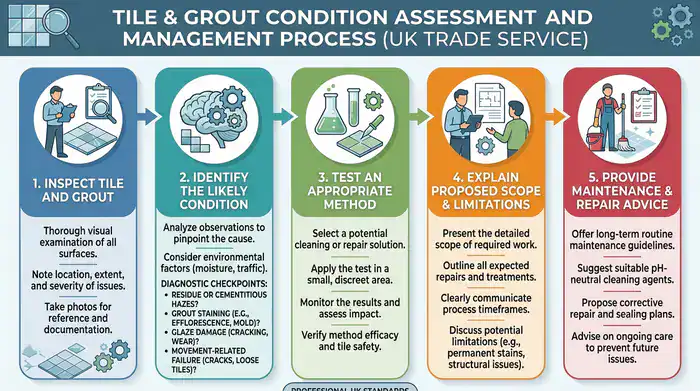
A credible restoration recommendation should hold up under scrutiny when the contractor examines the grout joints and tile surfaces after explaining the proposed work, rather than relying solely on a product name that promises a renewed finish. It should identify what has been observed, which part of the installation the method addresses, what appearance cannot be restored, and what maintenance outcome should follow.
Material suitability is the first criterion. A proposal should differentiate glazed ceramic from polished porcelain, unglazed tile, and natural stone, as mechanical refinishing can damage a ceramic glaze, and tile sealer can leave residue on a non-porous surface.
The second criterion is defect completion. The contractor should specify whether the issue involves polymer grout haze, discoloured grout, mould, glaze crazing, a chipped body, or lippage, then connect that condition to the visible evidence and the proposed correction.
Realistic limitations must be clarified before work commences, not after an unsuccessful treatment. A sound explanation will indicate that grout recolouring can enhance the visual frame, residue removal can reveal an intact surface, and a missing or damaged factory finish may necessitate replacement.
Care guidance constitutes the third criterion, as the outcome relies on subsequent actions. The contractor should explain why pH-neutral cleaning, grit removal, and appropriate drying safeguard the result, while abrasive pads, bleach, and acidic everyday products can reactivate surface contamination or weaken grout.
A trustworthy restoration recommendation builds confidence when it links material, defect severity, and expected maintenance instead of relying solely on product claims. The floor should show a significant improvement after intervention, be easier to clean and maintain, and maintain a clear distinction between recoverable appearance issues and conditions requiring Tier 2 repair.
Homeowners comparing recurring dullness with genuine damage may find it beneficial to consult why ceramic tile floors can appear dull post-cleaning before accepting a treatment description. This context helps differentiate residue lock-in, where cleaning residue or soil is retained on the surface and manifests as recurring dullness, from a permanently altered surface; targeted residue removal may enhance the appearance, but a general explanation cannot replace a thorough site assessment.

David Allen — Abbey Floor Care
David Allen possesses over 30 years of expertise in ceramic tile restoration and related floor-care advice throughout the UK via Abbey Floor Care. His educational initiatives aim to assist homeowners in distinguishing recoverable residue and grout deterioration from glaze damage, exposed tile bodies, and installation defects, ensuring that the correct restoration boundaries are clear.
The Article Ceramic Tile Restoration: What Can Be Restored and What Cannot? first appeared on https://abbeyfloorcare.co.uk