Last Updated on October 2, 2026 by David
Glazed ceramic tiles are kiln-fired, resulting in a vitreous surface that cannot be mechanically polished to regain their original lustre. Typically, a dull appearance arises from surface residue, dirty grout, or detergent accumulation rather than a worn glaze.
In most cases, a dull glazed ceramic floor requires the removal of residue or improvements in grout rather than abrasive refinishing. The factory-fired surface represents the tile’s intended finish. It is crucial to differentiate between a masked glaze, a matte or textured finish, soiled grout, and actual glaze damage to avoid irreversible polishing errors.
Can Factory-Glazed Ceramic Tile Be Polished? Understanding the Severity of Surface Issues
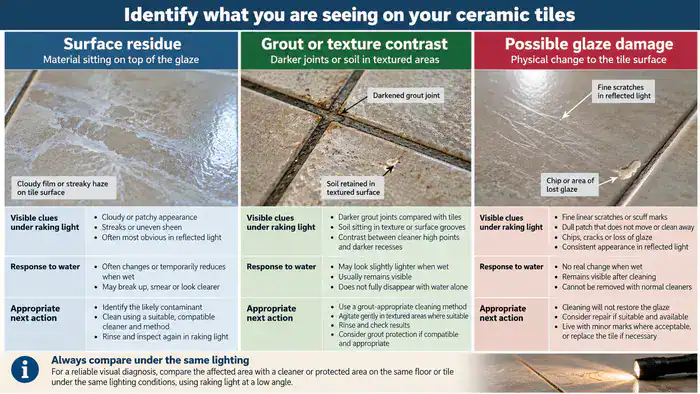
If your ceramic tile displays a dull patch that looks altered, compare it to an unaffected area under the same lighting conditions before concluding that the finish has been honed or damaged. If the patch’s appearance changes with the angle of view, moisture level, or lighting, it may be due to surface residue or grout issues, rather than a compromised tile surface. Proper assessment of the visible problem is essential before labelling it as ceramic tile honing.
A genuinely damaged finish tends to exhibit a fixed change in the tile’s appearance, rather than a removable film. Breached glaze may result in scratches, chips, or rough marks that persist even after appropriate cleaning. An exposed porous tile body can attract dirt more easily than its surrounding vitreous surface, heightening the severity of the assessment since the original protective layer is no longer intact.
Glaze crazing presents a distinct pattern characterised by fine hairline cracks across the decorative surface. Homeowners might observe dark lines, uneven colouration, or recurrent staining along these cracks, particularly in older tiles or damp bathrooms common in the UK. Unlike ordinary dullness, these lines follow a fixed network rather than appearing as a general film across the surface.
Water ingress through damaged glaze becomes significant when a chip or scratch reaches the underlying tile body. The affected area may darken after washing, retain moisture longer, or show staining around the defect, while an intact glazed surface generally resists moisture absorption. This distinction is crucial for identifying changes within the tile versus those occurring on its surface.
Such distinctions help maintain realistic boundaries for ceramic tile restoration. Residue, grout staining, and surface dirt can alter the appearance of tiles without affecting the tiles themselves. A valuable resource explaining the differences between recoverable appearance and genuine ceramic damage can be found in what ceramic tile restoration can and cannot restore, which helps prevent cosmetic concerns from being mistaken for a need for honing.
Understanding Why Polishing Cannot Restore the Glaze: Insights into Ceramic Tile Material and Structure
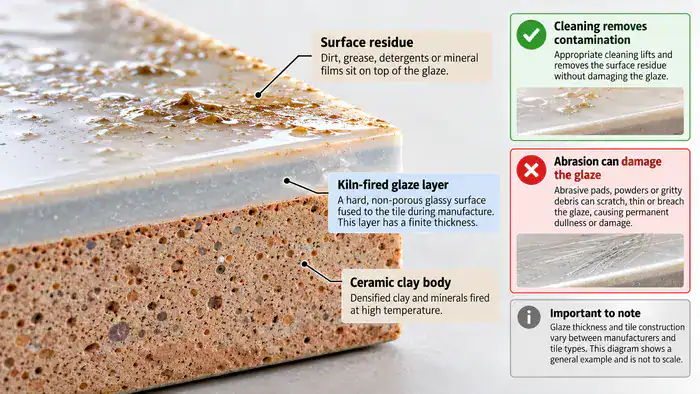
If your ceramic floor appears dull, worn, or marked, polishing is unlikely to restore its original shine. Observing a textured ceramic tile from a low angle reveals why the manufactured surface cannot simply be recreated through honing. Beneath the kiln-fired clay body lies a finite factory glaze: the body is formed from clay and mineral components shaped under pressure, then fired to harden the structure before the protective glaze undergoes its final kiln treatment. The outcome is a durable, easy-to-clean surface, not one designed for subsequent polishing.
The factory glaze provides a vitreous, non-porous, and permanent finish that carries the tile’s colour, pattern, and intended sheen. Ceramic tile polishing compounds cannot recreate that fused layer once abrasion has penetrated through it, as polishing alters the surface physically, whereas manufacturing involves heat and material fusion. Cleaning may reveal the existing glaze, but abrasive honing cannot restore its original cleanability characteristics.
Diamond polishing pads introduce similar issues through a different mechanism. Coarse pads remove material, while fine pads may produce a temporary glossy appearance through buffing or residue transfer. Neither approach recreates the kiln-fired surface. Applying excessive pressure can leave scratches, expose the underlying tile body, and complicate future cleaning, particularly on dark or glossy tiles.
Textured and anti-slip finishes require special attention, as their grooves contribute to slip resistance in UK wet rooms. Abrasion can soften or modify these micro-features, while trapped residue can diminish grip without altering the tile itself. A safe-cleanability check assesses whether cleaning can reveal the existing finish rather than whether honing can manufacture a new one.
Identifying Residue That Appears Like a Worn Finish: The Impact of Surface Structure, Micro-Features, and Grout
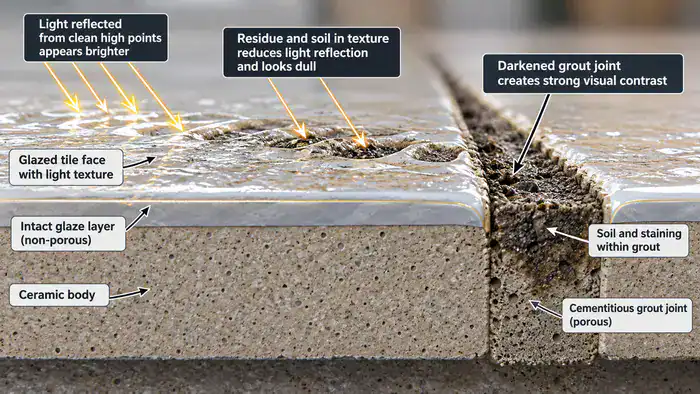
Addressing a dull-looking ceramic floor as if it were a case of worn tile can easily distract from the condition of the grout and textured areas. A clean-looking tile surface adjacent to dark grout often indicates a broader installation issue rather than glaze failure, particularly if strong detergents, hard water, or incomplete post-installation cleaning have left behind residue.
Textured tile grooves can trap fine soil, which ordinary mopping may merely wet and redistribute. Matte ceramic surfaces may show dust marks, water spots, and cleaning-product residue more readily than smooth glossy surfaces, while anti-slip finishes can retain soil from foot traffic around raised and recessed features. Variations in light across contaminated textures can resemble a worn finish remarkably well.
Cementitious grout porosity creates another pathway for soiling. Porous grout contains capillary voids within its structure, allowing substances like cooking grease, body oils, mineral films, and dirty mop water to infiltrate the joint and absorb soil. Darkened grout can frame every tile, resulting in an aesthetic failure even when the adjacent ceramic surface remains intact.
Metal residue transfer tends to be more localised. Soft metal from furniture feet, aluminium contact, or cleaning equipment can leave a dark scuff mark on the glaze; it is a mechanical deposit sitting atop the tile rather than a scratch, especially when the mark has no groove and does not catch on a fingernail. Non-abrasive removal methods protect an intact surface much better than aggressive buffing.
Genuine defects remain fixed even after residue and grout conditions change, while embedded soil follows grooves, joints, or contact paths. Homeowners can benefit from understanding why ceramic tile floors still appear dull after cleaning before assuming that honing will resolve the issue.
Effective Alternatives to Abrasives: Cleaning Methods and Long-Term Maintenance Strategies
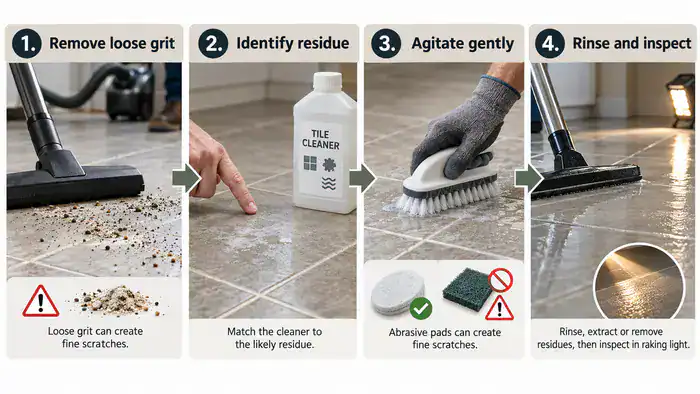
If your ceramic tiles appear streaky, dull, or lightly scratched following cleaning, inspect the tile at a low angle for fine linear marks before considering any abrasive treatment. Abrasive grit contamination poses a surface risk when loose particles remain underfoot or beneath cleaning equipment. Small particles, sand, and crumbs can act like sandpaper between a mop head and the glaze, generating fine scratches when the goal was merely to remove soil.
Cleaning choices must distinguish between removable soil, residue, transfer, and altered glaze. A vacuum or careful sweeping can eliminate loose dust before wet cleaning, while a pH-neutral cleaner with mild surfactants supports residue-free routine maintenance without etching or weakening grout. Soft-bristle brushes and non-abrasive sponges can agitate joints and textured areas without intentionally cutting into the glazed surface.
When the appearance suggests contamination, the process should be conceptual rather than a polishing programme:
- Compare the affected tile with a nearby clean-looking area in the same light.
- Remove loose grit before wet cleaning to prevent small particles from causing abrasion.
- Assess whether the pattern follows grout joints, textured grooves, water marks, or contact lines.
- Discontinue any abrasive treatment if scratches, altered texture, or reduced grip become apparent.
Long-term maintenance preserves both appearance and grip by removing grit prior to wet mopping and avoiding detergent film. Addressing UK hard-water deposits, bathroom limescale, and kitchen grease requires effective residue control rather than repeated buffing. A suitable safe ceramic tile cleaning approach explains the importance of extraction, as ordinary wiping may leave contamination behind.
Proper ongoing care maintains the original finish and assists anti-slip surfaces in retaining their intended performance. Avoid detergent-heavy products, as their residues attract new soil and can initiate a cycle of accumulation and bonding, resulting in a dull appearance and increased dirtiness shortly after cleaning.
Understanding Why Sealing Cannot Restore the Tile Surface Shine
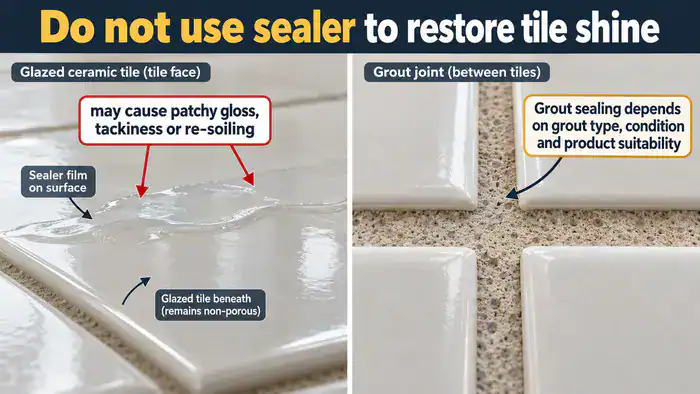
If your glazed ceramic surface appears dull next to darker grout, applying a sealer will not restore its shine or repair damaged glaze. The tile surface already presents a non-porous barrier, meaning that any coating will sit on the surface rather than penetrate into an absorption pathway. This can lead to patchy gloss, tackiness, and quicker re-soiling when a product meant for porous materials is applied to ceramic.
Standard glazed ceramic differs from adjacent cementitious grout, as grout features open pores while the factory surface does not. A penetrating grout sealer can limit absorption within the joints, but it cannot reverse honing marks, remove scratches, or rebuild the fired decorative layer. This explains why a grout treatment might enhance the overall floor appearance without altering the tile surface.
Unglazed ceramic tiles are an exception, as their exposed clay surface can absorb moisture and stains. This porous surface may require a carefully selected protective treatment, whereas a matte appearance alone does not indicate that a glazed tile lacks protection. The material, finish, and installation history need to be evaluated to determine whether sealing pertains to the tile or merely to the grout.
A professionally restored installation can significantly improve the overall appearance when surface residue and discoloured joints no longer obscure the original finish. Grout renovation can sometimes enhance the floor’s appearance beyond its initial installation, making it easier to clean and maintain when grout protection is appropriate for its porosity. Applying a coating to the wrong surface can create additional maintenance issues instead of a lasting shine.
Recognising When Ceramic Tile Polishing Compound or Diamond Pads Cause Tile Damage
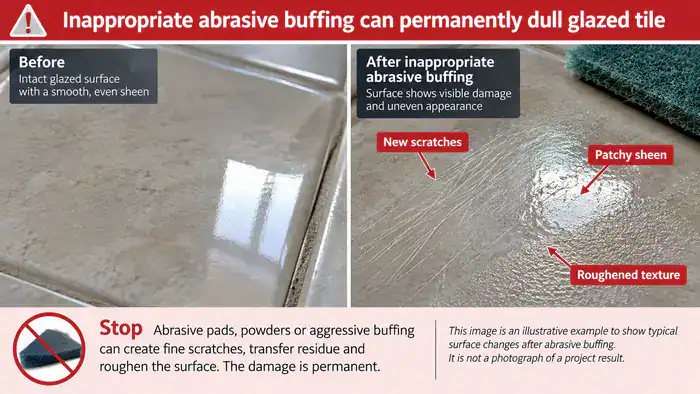
If buffing has resulted in new scratches, uneven shine, or altered texture on your floor, cease the process before the damage becomes irreversible. Examine the floor under raking light and stop if new scratches or changes to texture become evident. A glossy area created by buffing may merely be transferred residue rather than an improved ceramic surface, while retained linear marks indicate that the actual surface has begun to change.
An abrasive compound designed for a different tile type can transfer fine particles across glazed tiles, heightening the risk of damage. Specialised pads can exacerbate mechanical abrasion.
Glaze breakthrough exposes a porous tile body that may trap soil in the damaged region. A homeowner might notice a rough patch, a darkening scratch following mopping, or a mark that fails to reflect light like the surrounding tiles. Further polishing cannot restore the original impervious layer. What began as an effort to enhance shine may now result in a permanent defect.
Metal residue transfer complicates the interpretation of abrasion damage, as a mechanical deposit may create a dark scuff line without cutting a groove into the glaze. A mark with no groove that responds to non-abrasive removal likely indicates transferred soft metal, while a line that catches on a fingernail suggests physical damage. Confusing the two may lead to unnecessary use of polishing pads.
Changes in slip resistance are another clear indicator to halt work on textured or anti-slip tiles. If grooves feel smoother, grip diminishes when wet, or cleaning leaves a visibly altered track, the intervention has impacted the surface features that ensure safety. Compare the floor to an untouched section before describing a temporary glossy area as restoration.
When to Engage Professional Tile Restoration Services: Criteria for Contractor Evaluation and Next Steps
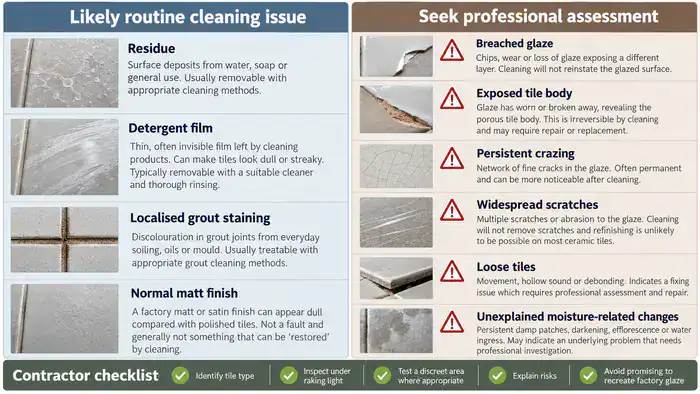
Enduring damage after proper care necessitates a professional assessment rather than further attempts at ceramic tile honing. A contractor should differentiate between routine residue, grout staining, and a non-reflective matte finish from breached glaze, persistent crazing, exposed tile body, or changes affecting safe usage.
A suitable contractor will evaluate the tile surface and grout separately, check for potential moisture sources, and distinguish tile damage from wet-room or joint issues.
An experienced contractor can recommend whether cleaning, grout renovation, recolouring, replacement, or no intervention is best suited to the discovered condition. The proposed work should maintain the factory glaze, avoid abrasive polishing on glazed ceramics, and take into account textured finishes, grout porosity, hard-water deposits, and the installation environment.
Homeowners should inquire about how the contractor intends to differentiate between surface deposits and retained scratches, whether grout and tile will be evaluated separately, and whether any proposed coating is appropriate for porous adjacent materials rather than the ceramic surface. These questions help focus the decision on feasible restoration or replacement options instead of a generic polishing assurance.
The appropriate outcome relies on the condition identified, but if contamination or grout appearance is the source of the problem, the floor should appear significantly improved after intervention. Proper ongoing care enhances cleanliness and extends the installation’s lifespan; broader principles can be found in the ceramic and porcelain floor-care hub.

David Allen — Abbey Floor Care
David Allen has over 30 years of experience assisting Abbey Floor Care clients in understanding the behaviour of ceramic tile, porcelain, and grout in UK homes. His expertise focuses on distinguishing residue, grout deterioration, and genuine glaze damage, helping homeowners preserve the original ceramic finish and avoid inappropriate polishing methods.
The article Can My Dull Ceramic Tile Floor Be Polished was first found on https://abbeyfloorcare.co.uk