Last Updated on November 16, 2026 by David
To effectively and safely eliminate a stain from marble tiles, it is crucial to first determine whether the blemish is due to absorbed staining, a surface deposit, or damage to the stone itself. Begin by blotting any fresh spills, cleaning gently with a pH-neutral cleaner that is compatible with marble, and then assess the dry surface. If a stain persists, it may require a treatment specific to the contaminant; conversely, a dull acid etch calls for specialist surface correction rather than a stronger cleaning approach.
No single stain remover is universally effective for all types of marble marks. Using the incorrect treatment can leave the original discolouration intact while creating a dull patch around it.
How Can You Identify the Type of Mark on Your Marble?
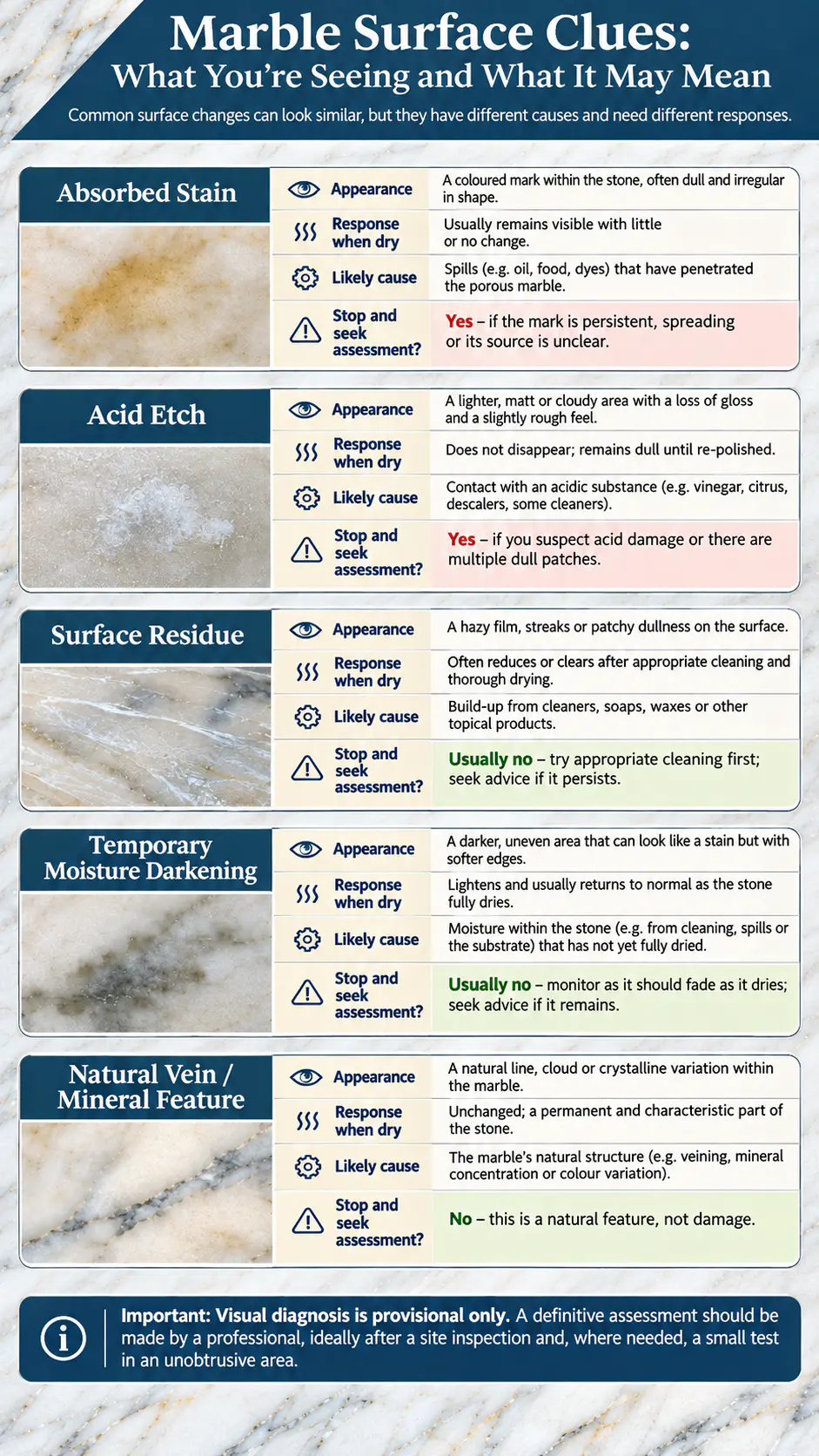
Examine the clean, dry tile from multiple angles, especially where light reflects off its surface. Take note of what substance was spilled, when the mark first appeared, and whether it changes as the floor dries. These observations will guide the treatment; however, appearance alone may not definitively reveal the cause.
| Observation | Possible Cause | Recommended Action |
|---|---|---|
| A darker or coloured patch that remains after gentle cleaning and drying | Absorbed oil, food, ink, or another contaminant | Identify the likely source before selecting a stain-specific treatment. |
| A dull, pale, or rough patch, particularly following a spill of food, drink, or cleaner | Acid etching, although residues can also dull the surface | Eliminate any removable residue, then seek advice about polishing or honing. |
| A smear or film that alters with cleaning | Cleaning residue, grease, wax, or an old coating | Test with a compatible cleaning product; persistent coatings may require professional stripping. |
| A raised or crusty mark around regularly wet areas | Hard-water mineral deposits | Avoid descalers. Arrange for marble-safe mechanical removal. |
| Loose white powder, especially if it returns | Salt deposits linked to moisture movement through the floor | Gently remove loose material and assess recurrence before sealing. |
| General greying or dull traffic lanes instead of an isolated stain | Soiling, micro-scratching, or both | Evaluate cleaning first; abrasion damage necessitates surface refinement. |
Natural veins and mineral features can sometimes be mistaken for stains. Marble’s absorption characteristics vary, and a trade name does not reliably indicate porosity or how it will respond to treatment. Avoid trying to bleach a feature simply because it differs from the surrounding stone.
What Immediate Actions Should You Take After a Spill?
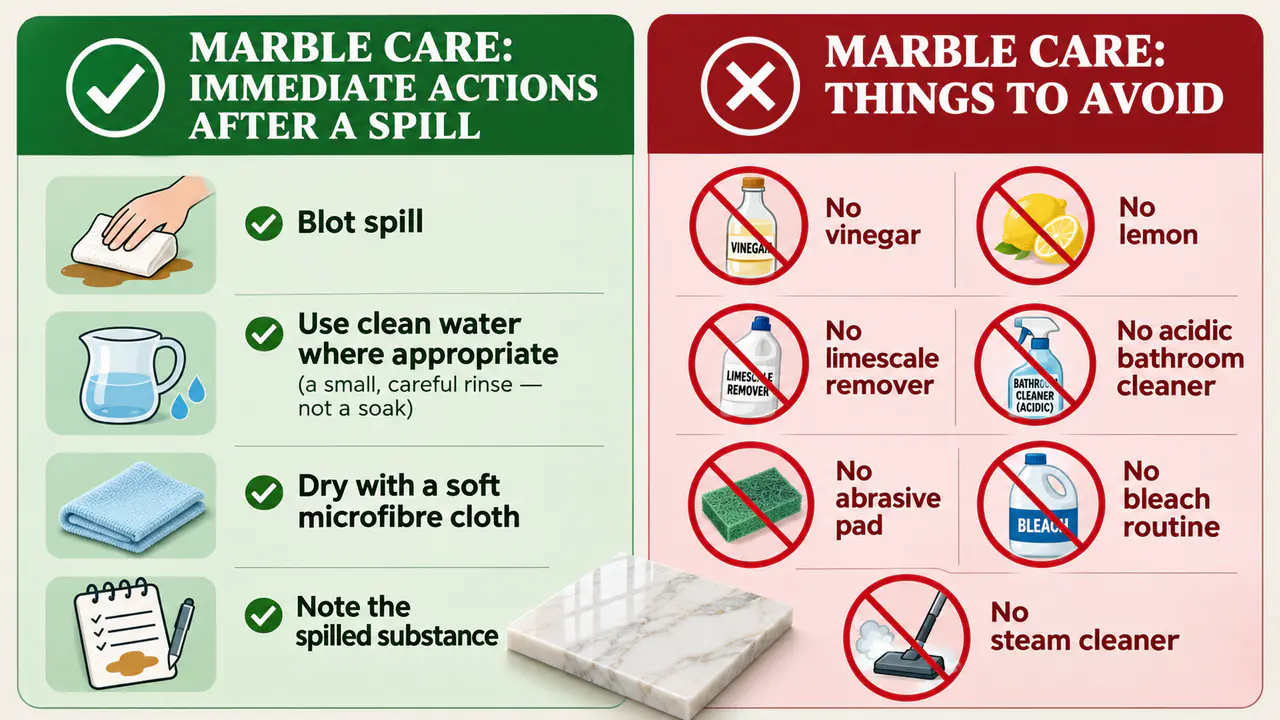
- Blot instead of spreading. Use a clean, absorbent cloth or plain paper towel to lift the liquid. Carefully remove solid material without dragging it across the tiles.
- Clean gently. Apply a small amount of an appropriate low-residue pH-neutral cleaner, strictly following the product instructions. Make sure it is approved for use on marble and its finish—not simply labelled as “stone cleaner”.
- Remove any residue. Wipe with a clean, slightly damp cloth, changing it as needed, and then dry the surface. Avoid flooding joints or fissures.
- Reassess once dry. Temporary darkening from moisture can complicate the situation. Avoid forming conclusions while the tile remains wet.
- Stop if the mark persists. Document the likely source and the products used before seeking expert advice.
Never combine cleaning chemicals. Steer clear of vinegar, lemon juice, acidic bathroom cleaners, and limescale removers, as all can etch marble, even when diluted. avoid abrasive pads, routine bleach-based cleaning, and steam cleaning, which can adversely affect the finish, sealants, or joints.
How Do You Distinguish Between a Stain and an Acid Etch?
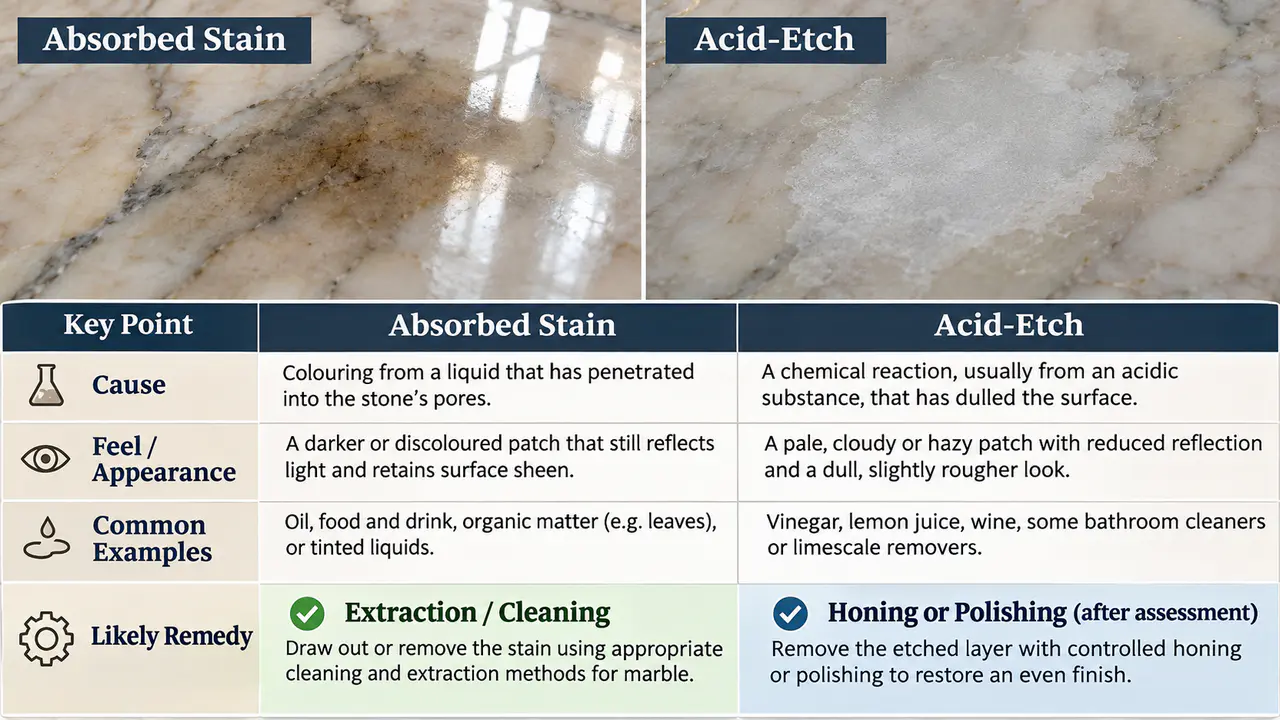
A stain refers to discolouration caused by a substance penetrating the stone. An etch, on the other hand, denotes damage to the surface itself. Most marble contains calcite, which reacts with acids, resulting in a chemically roughened surface, akin to the way eggshell dissolves in vinegar.
Substances like wine, fruit juice, vinegar, and acidic cleaning products can cause both etching and staining. Removing the colour may expose a dull patch beneath, which does not necessarily indicate that stain removal has failed.
Cleaning cannot reverse etching. Light damage may respond to compatible specialist repolishing. More severe etching may require diamond honing followed by polishing, or refinishing to match an existing honed finish. These techniques permanently remove some stone, so the treatment must align with the severity of the damage, tile thickness, and installation conditions.
Avoid excessive scrubbing of a dull patch or applying household polishing compounds in an attempt to restore shine. Localised treatment can result in a noticeably different reflection compared to the surrounding tiles.
How to Select the Right Treatment for an Absorbed Stain?
The type of contaminant is more significant than the colour of the stain itself. A specialist may opt for a marble-compatible alkaline cleaner, solvent, oxidising treatment, reducing treatment, or poultice after conducting tests. These represent different treatment avenues, rather than interchangeable household remedies.
Oil, Grease, and Cosmetics
Cooking oil, grease, and certain cosmetics can lead to dark patches. Surface grease may be addressable with compatible cleaning, while absorbed oil could necessitate a specialist solvent-based or poultice treatment. Repeated scrubbing will not reliably extract the contamination from within the stone.
Tea, Coffee, Food, and Other Organic Stains
These spills can result in brown or yellow discolouration. A specialist may employ an appropriate oxidising treatment or poultice, depending on the nature of the contaminant, the type of stone, and the existing sealant. Acidic food and beverages can also cause surface etching, meaning that colour removal and finish correction may be two distinct tasks.
Rust and Other Metal Stains
Metal items may leave stains that correspond to their shape. Orange-brown marks may also involve iron-bearing minerals within the stone. Avoid using a general rust remover unless it is explicitly confirmed as suitable for marble; acidic formulations can cause damage. Deep internal iron oxidation may improve only partially or may persist.
Ink, Paint, and Unidentified Coloured Marks
Where possible, identify the type of ink or paint and keep its packaging. Treatment will depend on its chemical composition and depth of penetration. Avoid experimenting with household solvents: ensure compatibility with the stone, sealant, and surrounding materials is verified first.
Soot and Smoke Marks
Differentiate between loose surface contamination and absorbed staining prior to wet cleaning. Avoid rubbing loose soot into the stone. Persistent discolouration around a fireplace should prompt specialist assessment rather than repeated general cleaning.
What Is the Function of a Marble Poultice?
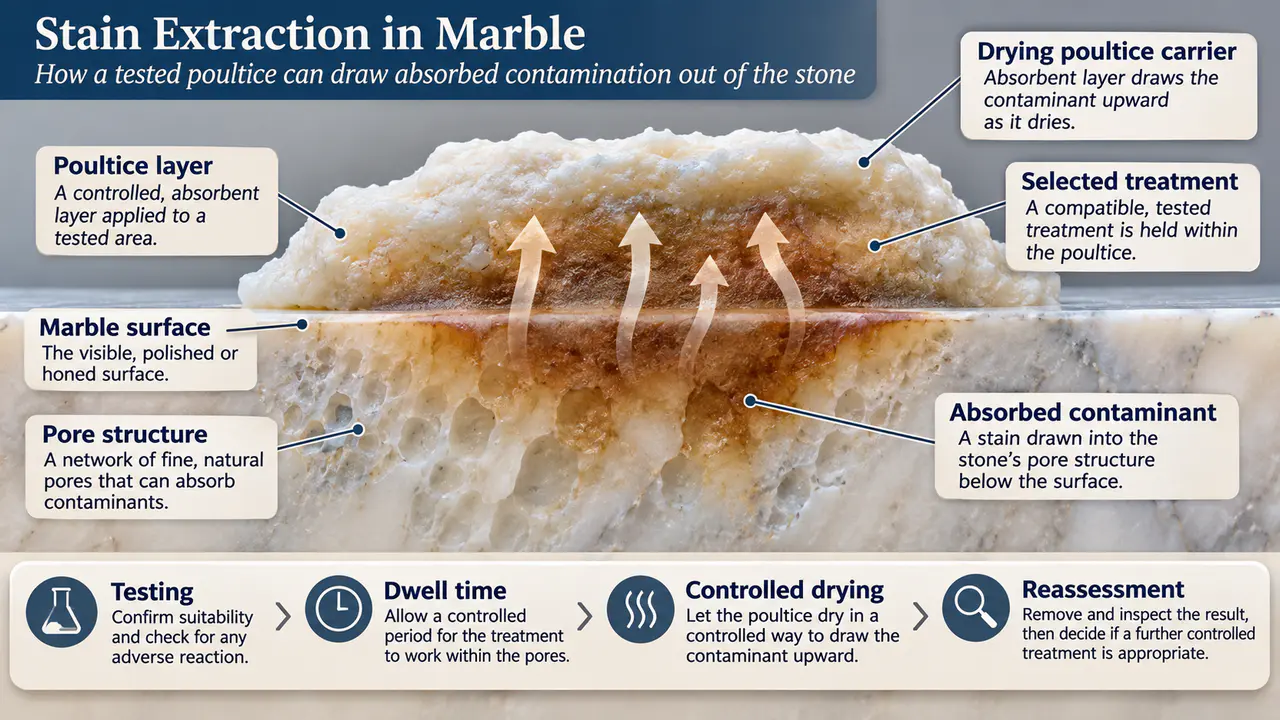
A poultice consists of an absorbent carrier combined with a treatment tailored for the stain. It holds this treatment against the affected area, allowing mobilised contaminants to migrate into the absorbent material as it dries.
This is not merely any household powder mixed into a paste. The active treatment, carrier, application method, contact duration, and removal procedure must be appropriate for both the contaminant and the marble.
- Test in an inconspicuous area and allow it to dry before evaluating any changes in colour or finish.
- Follow the specific product instructions instead of relying on a generic overnight recipe.
- Protect nearby materials and adhere to ventilation, glove, and eye protection guidelines.
- Evaluate the dry result before considering a subsequent application.
Some stains may require multiple controlled treatments, but repetition is not automatically beneficial. Cease application if the surface changes, the mark spreads, or further treatments yield no visible improvement. Deep staining might not be entirely removable.
A Safe DIY Poultice for Minor Organic Stains
For small, recent organic stains—such as those from tea, coffee, or food on light-coloured marble—a simple DIY poultice can sometimes safely lift absorbed discolouration. This should only be attempted on confirmed organic staining; it will not rectify acid etching, and using an inappropriate liquid on oil, rust, or dark stone may exacerbate the mark.
Required Materials:
- An inert absorbent powder: Unscented white kaolin clay, diatomaceous earth, or a proprietary stone poultice powder. Avoid coloured clays or gritty household powders that could scratch or transfer pigment.
- A compatible liquid: Clean distilled water, or a standard 3% (10 vol) plain hydrogen peroxide solution for light-coloured marble only. Do not use peroxide on dark or heavily pigmented marble, as it may lighten the stone’s natural colour.
- Application tools: A plastic or wooden spatula, breathable paper masking tape, and clear plastic food wrap.
- Pre-wet the area slightly. Dampen the stained marble with clean distilled water to allow the stone’s pores to accept the treatment uniformly instead of pulling the liquid in too aggressively.
- Mix to a thick paste. Combine your powder and chosen liquid in a clean plastic bowl until it reaches a consistency akin to thick peanut butter—moist enough to adhere but not runny.
- Apply and cover. Spread a layer approximately 5–6 mm (about a quarter-inch) thick over the stain, extending 10–15 mm beyond the edges. Cover with plastic wrap and tape down the edges to slow the initial drying, then pierce a few small holes in the plastic to allow moisture to evaporate gradually.
- Allow it to dry completely. Let the poultice sit undisturbed for 24 to 48 hours until the paste dries to a crumbly powder. Extraction occurs as the moisture evaporates upwards.
- Remove, rinse, and assess once dry. Carefully lift the dried powder with a plastic scraper, wipe the area with a clean cloth dampened with distilled water, and allow the stone to dry fully before evaluating the outcome.
If the mark lightens slightly, one controlled repeat may be beneficial. If there is no change—or if the surrounding stone appears dull—stop and seek expert advice prior to attempting stronger chemicals.
What Approach Should Be Taken for Water Marks and White Deposits?
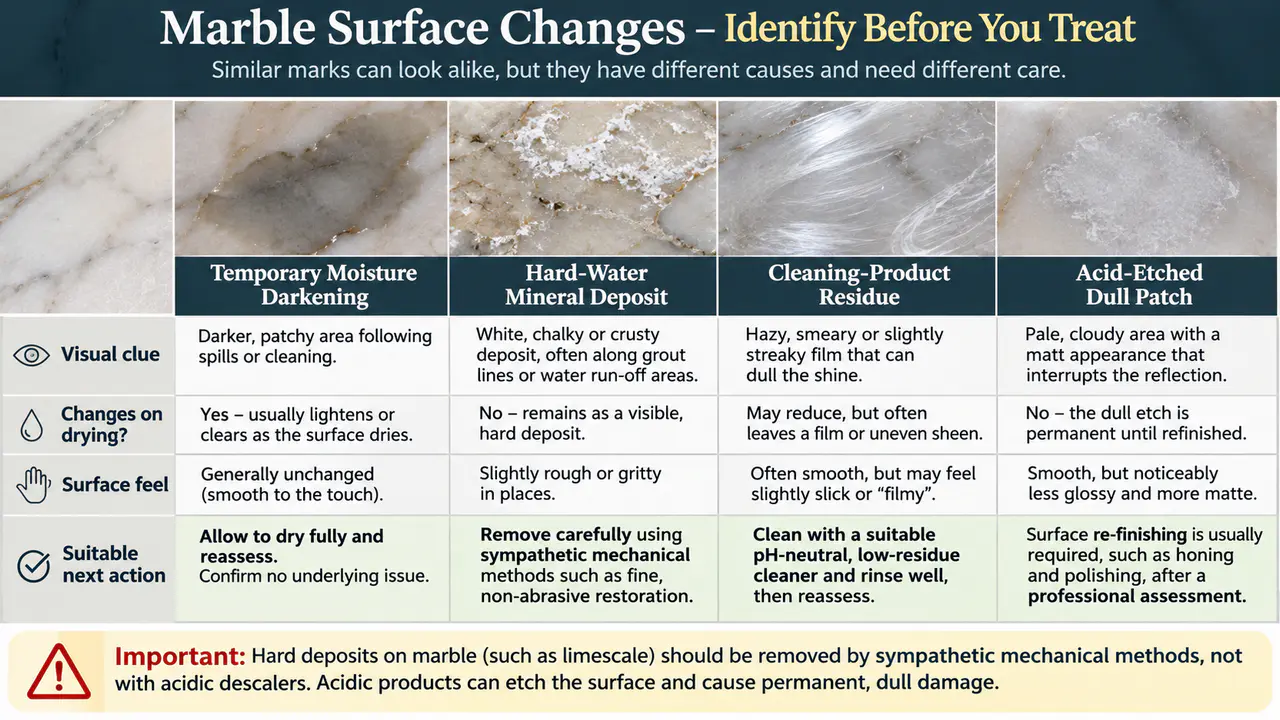
A “water stain” may be temporary moisture darkening, a mineral deposit, residue, or an etched area. Allow the floor to dry before determining which is present prior to treatment.
Hard-water deposits are particularly pertinent in bathrooms and wet areas. On marble, these require careful mechanical removal—not acidic descaling. Aggressive scraping or abrasive pads can damage the finish, so bonded deposits are best assessed by a specialist.
Loose white salts, known as efflorescence, can emerge as moisture travels through a floor and evaporates. Gently collect the loose dry material using a soft brush and a suitable vacuum without grinding it into the surface. If deposits recur, the next step is to evaluate floor moisture movement, bedding, or subfloor conditions and their implications for treatment. White deposits alone do not determine their source.
Avoid applying a coating to conceal recurring salts or unexplained darkening.
When Is Professional Treatment the Best Option?
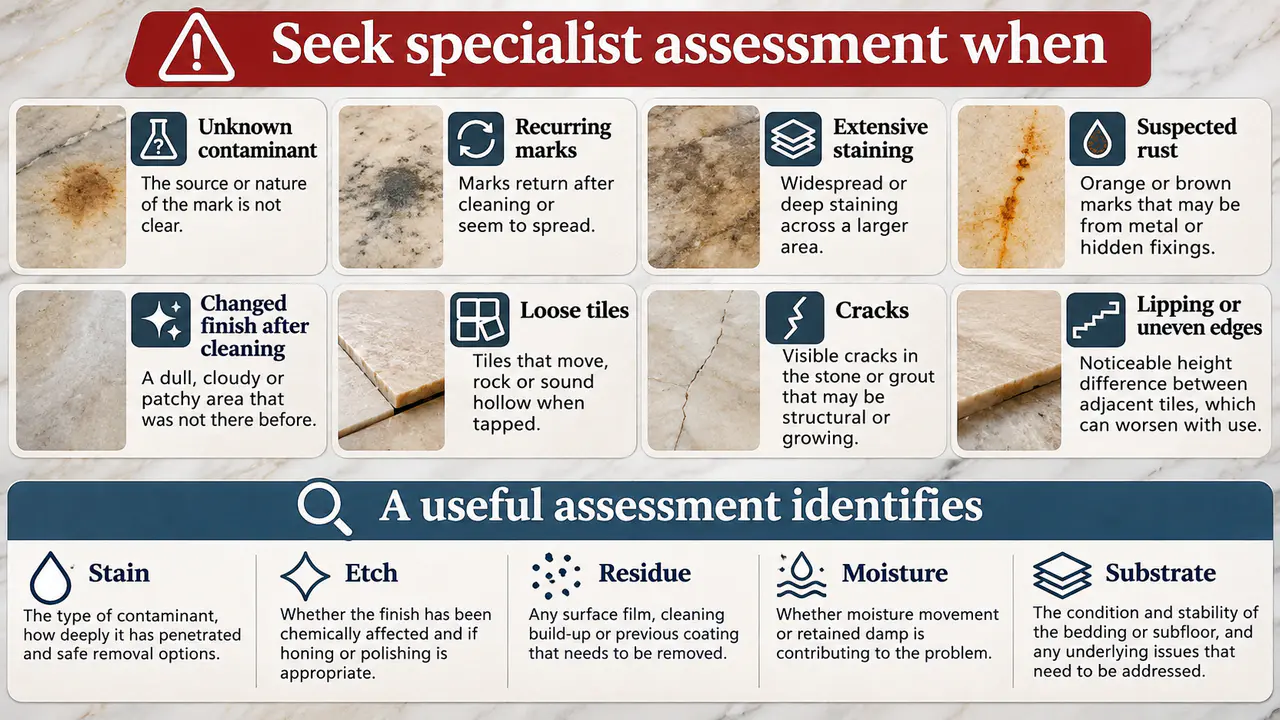
Seek expert advice when the contaminant is unknown, the mark is extensive or recurring, metal staining is suspected, or previous attempts have altered the finish. Loose tiles, significant cracks, and uneven edges also require evaluation before any abrasive work.
A comprehensive assessment should differentiate between contamination and damage, identify a suitable test treatment, and clarify the likely limitations. Grinding or honing is not a reliable substitute for extracting a deep stain; the discolouration may extend beyond the layer that can be safely removed.
Professional deep cleaning additionally involves controlled agitation, thorough rinsing, and extraction of the solution used. Leaving dissolved dirt or treatment residue on the floor can lead to re-soiling and interfere with subsequent sealing.
Can Sealing Prevent Stains from Reappearing?
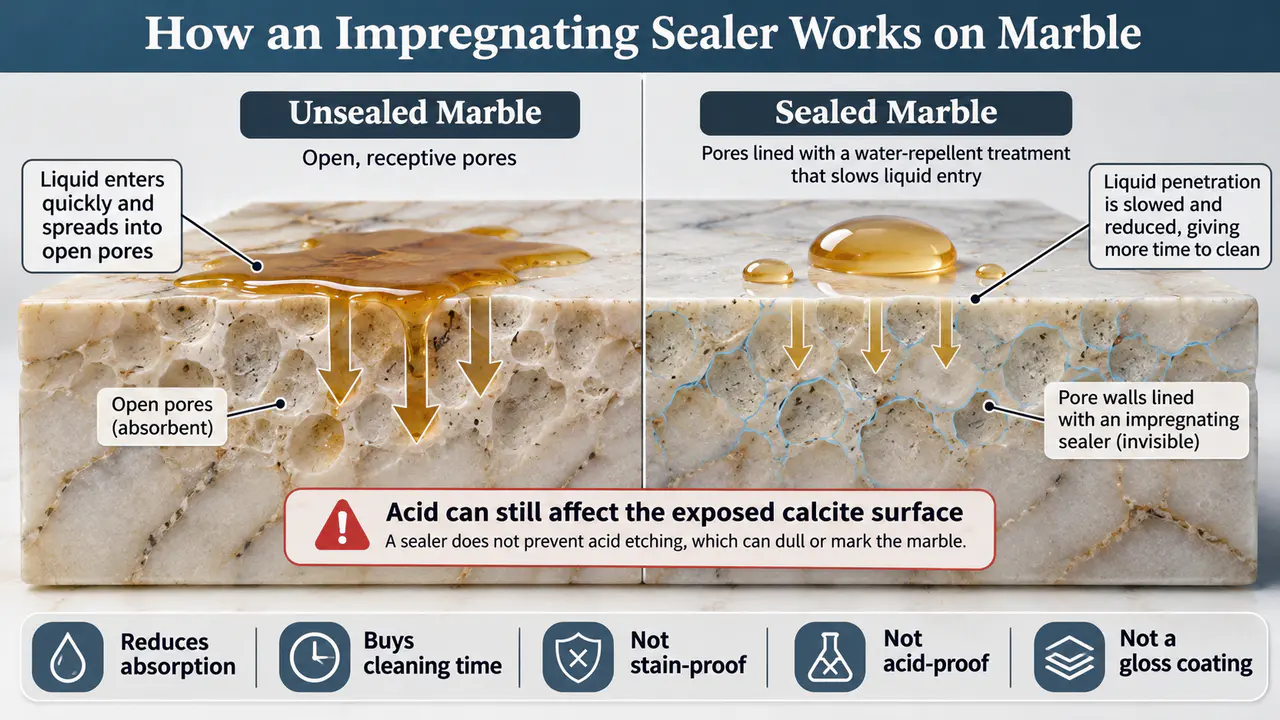
A suitable impregnating sealer reduces the absorption of liquids and provides additional time to remove spills. It penetrates the stone without forming a surface film. it does not render marble stain-proof, prevent acid etching or scratching, or create a polished finish.
After professional marble honing or polishing, Abbey Floor Care typically employs a suitably selected impregnating sealer following complete slurry removal and appropriate drying. The choice of product and timing depends on the marble, existing treatment, and site conditions. Any excess sealer must be removed before it dries to avoid haze and streaks.
A topical, film-forming sealer sits on the surface and is not the standard recommendation for marble. It has additional adhesion, moisture, and maintenance requirements; it should not be utilised simply to obscure a stain or dull patch.
There is no universal rule for annual resealing. Reassess protection levels based on absorption, exposure, maintenance, and the guidance of the sealer manufacturer.
How to Simplify Future Stain Removal
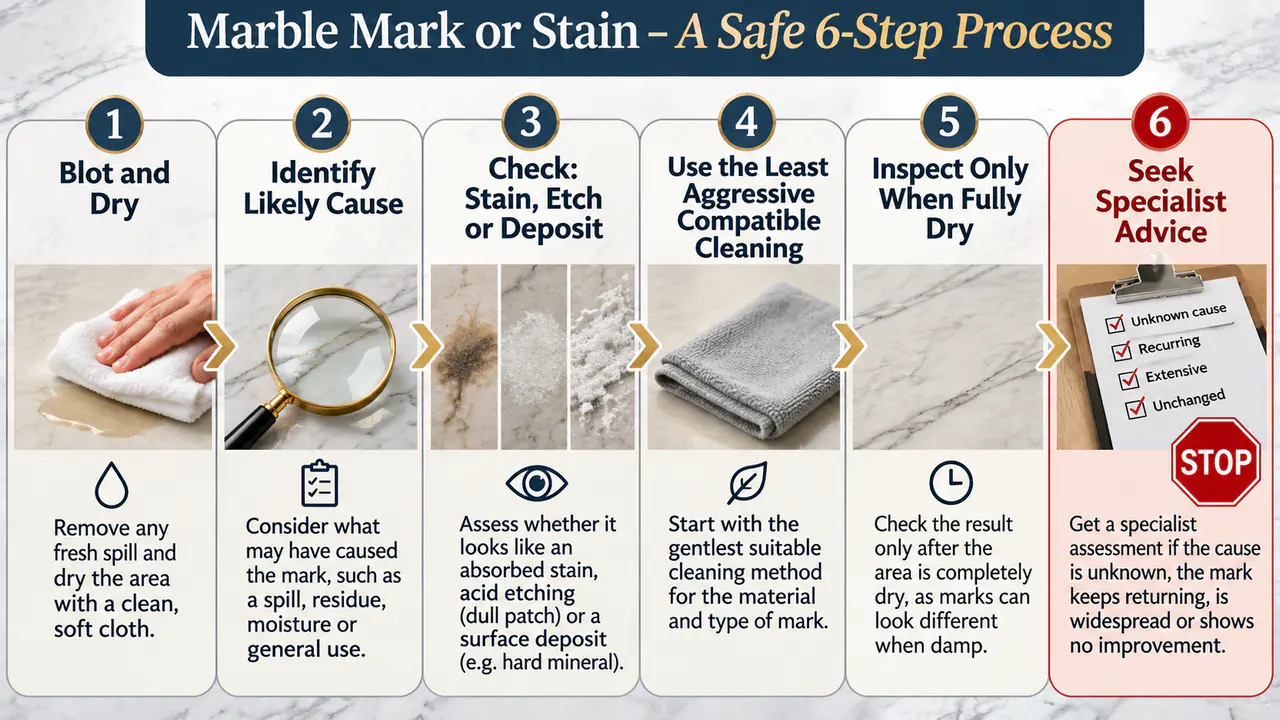
- Promptly remove spills, especially acidic beverages and oily foods.
- Dry sweep or vacuum with a suitable non-scratching attachment before damp mopping.
- Utilise a low-residue pH-neutral cleaner that is approved for the floor and finish.
- Maintain clean grit-controlled entrance mats, and use trays under products likely to drip.
- Prevent prolonged contact with wet metal items and check protective furniture feet.
The main decision is whether the mark requires cleaning, extraction, or surface correction. Start with the least aggressive compatible cleaning method, assess the result once dry, and avoid escalating to stronger chemicals without determining the cause. For comprehensive maintenance and repair guidance, refer to the marble care, cleaning, repair, and restoration guide.

David Allen — Abbey Floor Care
David Allen of Abbey Floor Care has over 30 years of practical experience in floor restoration. His expertise encompasses marble cleaning, stain treatment, honing, and polishing, with a particular focus on distinguishing between absorbed staining and surface damage.
The Article Marble Stain Removal: Identifying Stains And Acid Etches first found on https://abbeyfloorcare.co.uk