
Last Updated on November 23, 2026 by David
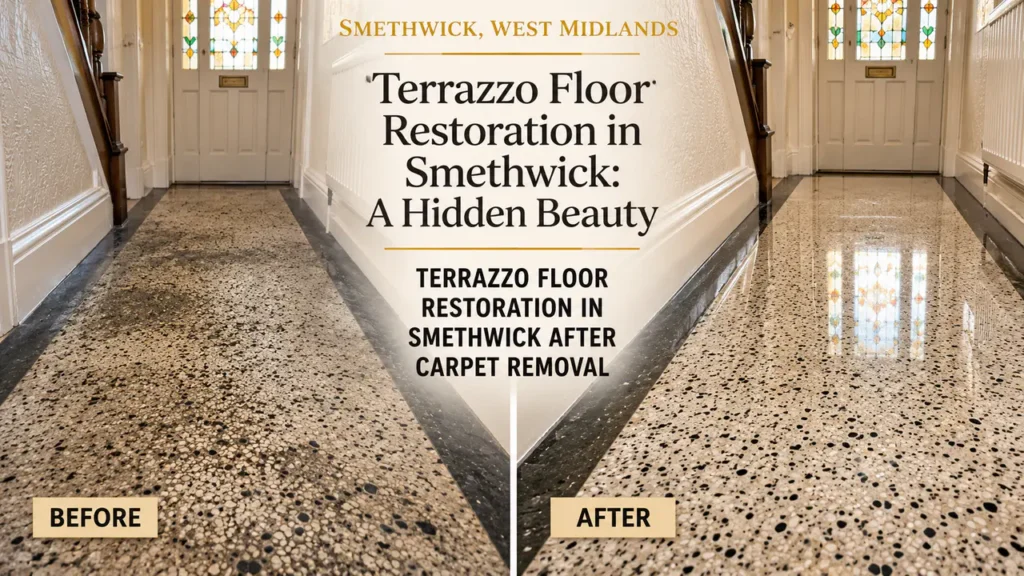
Can a terrazzo hallway with cracked repairs, gripper-tack holes, and a worn surface be transformed into an elegant feature once more? In this Smethwick residence, we expertly restored the damaged areas, grinding and honing the terrazzo to achieve a deep, lustrous shine. This project also included a polishing setback that required additional hours to rectify.
Unveiling a 1930s Terrazzo Floor Beneath Carpet
The homeowner discovered the original terrazzo flooring after lifting the hallway carpet during a comprehensive restoration of their property in Smethwick, West Midlands. They expressed a desire to keep the floor and have it restored and polished to a sophisticated finish.
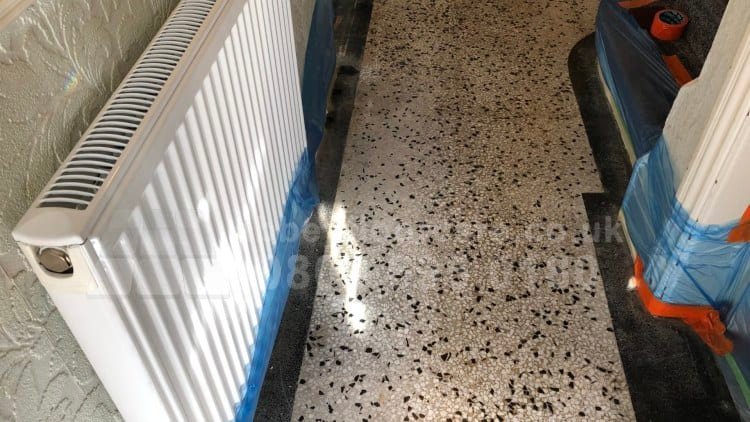
The floor required more than just a surface clean. Cracked and unsightly old cement repairs in the doorways needed attention, and the removal of carpet gripper tacks had left numerous holes. Both the Portland cement binder and the marble chips exhibited signs of wear, and the cement surface was powdery and porous.
The floor also had a history of being cleaned with harsh alkaline products. While this history is significant, it is important to note that alkalinity alone does not explain the deterioration of terrazzo; factors such as wear, the concentration of cleaners, abrasion, and residue can all impact its condition. In this case, our repair work and mechanical refinishing effectively addressed the damaged areas and the worn finish.
Restoring Damaged Doorway Repairs
Prior to commencing the polishing process, we protected the walls from slurry splashes and marks. Transition bars were used to cover the joins between the hallway and the new flooring in the main rooms. These bars were attached with a thin, flexible adhesive and were carefully lifted without causing damage to either the bars or the flooring.
We carefully broke up the old cement infill using a hammer and chisel, removing any loose material. Beneath this, we found that the subfloor within the repair area was damaged and loose, so merely covering the old patch would not have resolved the underlying issues.

We poured a low-viscosity resin filler into the repair to stabilise the loose subfloor, thereby preventing further movement. Once the resin cured, we reinforced the repair with glass fibre to cover the remaining holes.
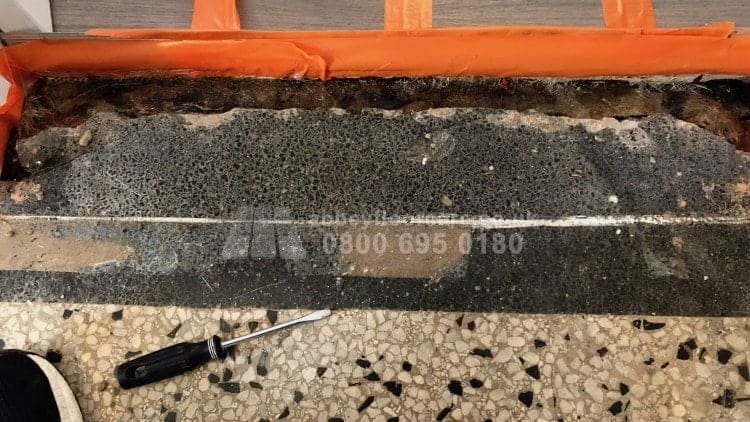
After the glass fibre cured, we filled the repair with black filler. We took some original terrazzo that had broken away, created small black chips, and mixed these with the black filler to form the surface of the repair. This method allowed us to reuse material from the floor itself, rather than relying solely on standard filler.

Once cured, the repairs were ground and honed to create a smooth finish that aligned flush with the existing floor. It is important to note that while a smooth repair can be achieved, it does not guarantee an invisible match in colour or aggregate.
Repairing Holes Left by Carpet Grippers
The smaller holes along the perimeter also required our attention. We filled these with black filler and black chips, then ground and polished the cured repairs to ensure they matched the surrounding floor.
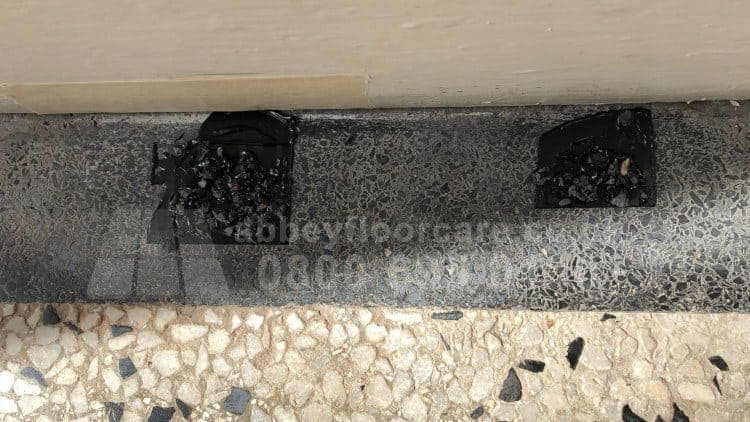
These local repairs addressed the damage caused by the carpet fixings and were distinct from the larger, cracked cement patches in the doorways.
Grinding, Honing, and Overnight Curing Process
While the terrazzo repairs were curing, we initiated the grinding process using metal diamond tooling. This step effectively removed the old, dull, porous finish. Following this, diamond honing was performed to eliminate scratches left by grinding and refine the surface.

Once honing was complete, we applied a densifier to enhance the surface’s strength and improve the final shine, leaving the floor overnight to cure. It is essential to understand that a densifier is a surface-strengthening treatment and should not be considered a substitute for a sealer.
Fine-diamond polishing followed, yielding a smooth finish in preparation for the final polishing stage.
Addressing a Polishing Setback: The Rectification Process
The polishing process encountered an issue. Small pieces of cement grit became trapped in the diamond tooling, resulting in deep scratches across a third of the surface.
This area needed to be honed and polished again, adding several additional hours to the project timeline. The scratches required further surface refinement before we could complete the final finish.
We concluded this project using super fine diamond polishing pads, which delivered a deep, lustrous shine.

The Final Result: A Restored Floor with a Brilliant Shine
The repairs around the doorways were seamlessly integrated into the existing terrazzo, the gripper-tack repairs were polished to blend with their surroundings, and the final polishing achieved a deep, lustrous shine.
For homeowners unearthing a similar floor, an important takeaway is that holes, old patches, and dullness do not necessarily indicate that the terrazzo needs replacing. This hallway required both local repairs and comprehensive surface refinement. The appropriate approach for another floor would depend on its stability, the remaining thickness of the terrazzo, and the nature of the damage.
For the routine maintenance of cement-and-marble terrazzo, use a compatible, low-residue, pH-neutral stone cleaner, regularly remove abrasive grit, and promptly wipe up spills. Avoid vinegar, acidic descalers, and unsuitable strong cleaners, as a polished finish does not render the cement binder or marble chips immune to acid damage.
Pro Tip: We recommend these products for daily terrazzo cleaning and interim resealing
Disclosure: As an Amazon Associate, Abbey Floor Care earns from qualifying purchases at no extra cost to you.



David Allen — Abbey Floor Care
David Allen of Abbey Floor Care boasts over 30 years of practical restoration experience. His expertise encompasses terrazzo repair, grinding, honing, and polishing, with a keen focus on the condition of both the cement binder and the marble aggregate.
The Article See For Yourself Why Our Customer Was Delighted With This Terrazzo Hallway Polishing Project in Smethwick B17 first found on https://abbeyfloorcare.co.uk