
Last Updated on October 11, 2026 by David
How Adhesive Concealed the Original Cement-Matrix Terrazzo in a Chesterfield College Hallway

After the removal of the previous glue-down tiles in the Chesterfield College hallway, the underlying areas unveiled the original marble-chip pattern and grey cement matrix. This stark contrast highlighted the fact that the hallway featured a 1960s cement-matrix floor, distinct from any modern replacement.
The floor showcased decorative marble chips set within a Portland cement binder, creating a robust aggregate composite typical of UK residential and institutional buildings from that era. The expansive hallway design catered to the practical needs of college life, accommodating heavy foot traffic along the main pathway connecting classrooms.
Despite the lifting of the tiles, remnants of adhesive lingered on parts of the exposed surface, obscuring the original terrazzo pattern from a standard viewing angle.
Many older institutional buildings in Chesterfield preserve durable finishes in their entrance halls and heavily trafficked corridors. In this instance, wear had accumulated beneath later coverings, with adhesive masking the floor’s inherent character. The traffic-induced marks surrounding the adhesive created a pervasive restoration challenge instead of a singular stain.
This historic environment demanded expertise in heritage building restoration. The objective was to accurately assess the condition and maintain a usable hallway surface, treating the existing material with due respect rather than considering it disposable.
Why Adhesive Stains Had Penetrated the Hallway Surface
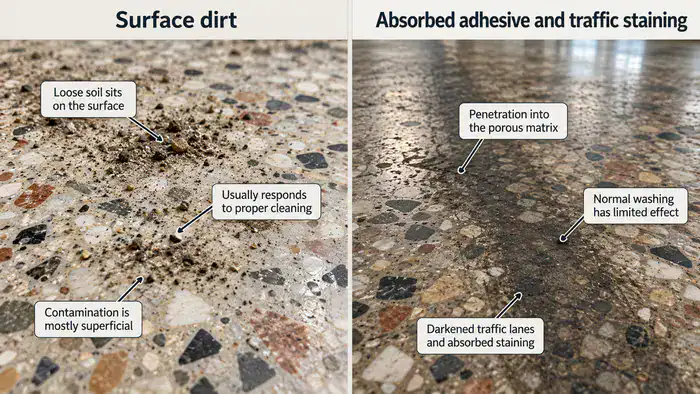
In consistent lighting, the presence of adhesive residue, dark traffic lanes, and dull patches indicated that the problem was more extensive than mere surface dirt. The affected lane appeared significantly darker than a adjacent section, despite both areas receiving identical cleaning attention.
The grey matrix interspersed between the marble chips had grown increasingly absorbent over time, enabling fine soil and adhesive stains to seep beneath the visible surface. This heightened porosity signified a weakening binder and deterioration of the cement, while surface friability elucidated why routine cleaning failed to restore the desired clarity.
The historical use of potent alkaline cleaning products had progressively damaged an already porous binder. Although alkaline chemistry can facilitate controlled deep cleaning and facilitate organic soil removal during professional preparations, residues must be thoroughly rinsed and contaminants extracted. Continuous household use cannot reverse the degradation of the matrix.
The visible dullness thus became a catalyst for restoration rather than a mere cleaning mark. The presence of cement deterioration, embedded soil, and surface wear was evident, with adhesive contamination keeping the original aggregate pattern hidden.
Why Mechanical Grinding Was Essential to Remove the Damaged Top Layer After Binder Deterioration

Simply scrubbing the adhesive-stained terrazzo would have left the absorbed contamination and dark traffic lanes intact. The deteriorated surface required controlled removal rather than another wash, so I oversaw the planetary grinding machine as it traversed the hallway.
The mechanical grinding process employed a planetary head to maintain even pressure across a broad area, while metal-bond diamond abrasives delivered the aggressive action necessary for coarse removal. The initial phase effectively cut through the adhesive, embedded soil, and degraded layer, establishing a flatter plane throughout the hallway.
Terrazzo, a composite of marble or granite aggregate set in cement or epoxy, requires a controlled diamond progression due to the differing rates of matrix and aggregate polish. In this instance, the metal-bond diamonds revealed fresher marble fragments and sounder cement beneath the contaminated surface. Careful machine supervision prevented unnecessary abrasion.
Grinding also unveiled pinholes and micro-voids within the aged matrix. These natural pores had been concealed by the worn binder, rather than resulting from machine damage. They could subsequently receive cement filler prior to further surface refinement.
For a broader understanding of this specialist process, refer to the professional terrazzo polishing process; the ongoing Chesterfield project serves as evidence for the techniques described here.
How Progressive Honing Was Necessary for Achieving a Smooth, Low-Sheen Finish

Using resin-bond diamond honing, I progressively refined the ground terrazzo. Under low-angle light, the remaining grinding marks faded as the surface acquired a smooth, understated sheen. The exposed marble chips became more defined as controlled abrasion replaced the coarse texture left from initial grinding.
I progressed through intermediate grits, starting with 100-grit and 400-grit, before advancing to 800-grit to eliminate scratches and refine the cement matrix. A honed terrazzo surface achieves a smooth matte finish, whereas a mechanically polished surface reflects the aggregate and matrix as a cohesive reflective plane under natural light.
The college hallway necessitated a satin finish instead of a high gloss, as the frequent institutional foot traffic demanded a practical surface capable of concealing minor wear. The completed honing resulted in a uniform matte look, enhanced aggregate visibility, and a finish that required less ongoing maintenance compared to a highly reflective surface.
Why an Impregnating Sealer Was Essential for Protection Against Future Spills
An impregnating sealer penetrated the absorbent cement matrix without leaving a visible film, enabling the restored hallway to maintain its natural low-sheen appearance. This treatment was ideal for the revitalised surface, preserving its practical satin finish.
The penetrating treatment filled microscopic pores and slowed the absorption process, allowing staff additional time to manage spills before staining occurred. It also facilitated easier routine cleaning while keeping the aggregate and binder visually unchanged.
The sealer did not render the surface immune to damage from acids, chemical dissolution, or scratching. An impregnator functions below the surface rather than forming a sacrificial wear layer. Acidic contact can still provoke an immediate reaction across the acid-sensitive matrix and decorative chips, meaning the treatment enhances resistance without providing complete immunity against misuse.
How the Marble Chips Regained Their Visibility
A highly reflective finish alone would not guarantee a successful restoration. Observing the Chesterfield hallway, the clearer marble chips, flatter plane, and smooth low-sheen surface provided a more significant comparison. The finished floor looked markedly improved compared to its pre-restoration state, as clarity was restored without compromising practical functionality.
Prior to restoration, chip visibility was obscured. Adhesive staining and embedded soil blended with the darkened cement binder, making the aggregate pattern challenging to discern across the previously tile-covered area. The surface appeared uniformly dull, despite the decorative chips being present beneath the contamination.
Following mechanical grinding and honing, chip visibility returned. Fresh marble fragments stood out against the refined cement matrix, and the clearer pattern connected the previously hidden section with the rest of the hallway. This improvement stemmed from surface renewal and progressive refinement, rather than merely increasing gloss.
Before restoration, the surface plane appeared inconsistent. Traffic lanes and adhesive deposits disrupted the visual flow, while the worn binder trapped soil in areas experiencing the highest foot traffic. The contrast between the affected lane and less-worn sections made standard cleaning seem inadequate.
After resurfacing, the hallway exhibited a flatter plane. Mechanical grinding corrected minor unevenness, and honing removed the visible scratch pattern, resulting in a smooth, low-sheen texture well-suited for college circulation. The outcome was a consistent matte appearance rather than a falsely glossy finish that would highlight every new mark.
The successful restoration fulfilled the institutional need for a hard-wearing, practical finish. It looked significantly better than the adhesive-stained initial condition, was easier to clean and maintain, and preserved the authentic visual character of an older cement-matrix floor.
Essential Maintenance Tips for the Restored College Hallway
Pro Tip: Recommended Products for Daily Terrazzo Maintenance Cleaning
|
Fila Pro Floor Cleaner
|
LTP MPG Sealer H20
|
Vileda H2PrO Spin Mop System
|
To maintain the smooth satin finish, clear aggregate visibility, and practical texture, the college should adhere to a regular maintenance routine tailored for this busy institutional corridor.
For this hallway, staff ought to safeguard the restored satin surface by removing grit before damp mopping with a pH-neutral cleaner, then scheduling resealing at appropriate intervals. Proper ongoing maintenance is the single most crucial factor in prolonging the floor’s lifespan, as dragging grit across the finish could abrade the marble chips.
Ongoing dullness following cleaning, recurring dark patches, or uncertainty regarding previously used products would warrant a specialist assessment rather than repeated treatments. The broader terrazzo flooring care and restoration information contextualises this completed Chesterfield project within a wider material framework.
The Chesterfield College project illustrated how mechanical resurfacing can reveal a concealed aggregate pattern and achieve a durable satin finish when cleaning alone fails to create change.

David Allen — Abbey Floor Care
David Allen brings over 30 years of expertise in restoring terrazzo and other hard floors through Abbey Floor Care. This Chesterfield College case study highlights how he effectively addressed adhesive staining, binder wear, and surface dullness, ultimately restoring the hallway to a clear, functional low-sheen finish.
The Article Terrazzo Cleaning In Chesterfield Could Not Remove Adhesive first found on https://abbeyfloorcare.co.uk